what prompted shakespeare to join the queens men?
Oxford in "Shakespeare Quarterly": The Dutton Brothers & The Queen'south Men
In the throes of a pandemic comes the Jump 2019 issue of the Folger Library'due southShakespeare Quarterly, delayed by bug in manufacturing; but no thing: a quick expect at the contents folio indicates that one of its articles undoubtedly mentions Edward de Vere.
Matthew Steggle, a Professor of Early on Modern English Literature at the Academy of Bristol, United kingdom, offers a well-researched piece titled "John and Laurence Dutton, Leaders of the Queen's Men," unwittingly supplying more testify that mainstream scholars are inexorably moving "Shakespeare" and the Earl of Oxford closer together. How long will it be before they realize that the two were one and the same?
In improver to supplying new information about the Dutton brothers, Steggle includes the known history that in 1580 they moved with the residuum of Warwick's actors to Oxford'southward visitor; and that "it was as one of Oxford'south Men that Laurence became involved in a brawl at the Theatre in Apr of that yr." Then in 1583, John Dutton was moved from Oxford's Men to the newly formed Queen'due south Men every bit one of the company'southward founding players
The Queen's Men soon dominated performances at Elizabeth's courtroom and began relentlessly touring the land. Steggle reports that the Duttons performed both at court and on tour for the company during that decade; and "between 1588 and 1593 they were co-leaders of the Queen's Men, the almost meaning theatre company of its era." Information technology appears the brothers "were in charge of that visitor when it produced many of the all-time-known of its 9 surviving plays. And if as is widely idea, Shakespeare was involved with the Queen's Men in some mode in his early on career, then he would take had to piece of work with the Duttons."
I take placed that concluding sentence in italics to highlight how this conjecture (that Will Shakspere may have spent his "lost years" with the Queen'due south Men) is now "widely thought" by current scholars to be truthful. If past practices are followed, it will not be long before the conjecture is offered to the globe equally fact.
We have seen this coming ever since Scott McMillin and Sally-Beth MacLean published their seminal work The Queen'due south Men and Their Plays in 1998, stating: "The plots of no fewer than six of Shakespeare's known plays are closely related to the plots of plays performed by the Queen'due south Men." They suggest, therefore, that the great author may take acted in those histories in the 1580s and memorized their lines, enabling him to plagiarize them for his own versions in the 1590s! The swain from Stratford-upon-Avon also may accept collaborated on those early plays for the Queen's Men! Afterwards all, how else could he come upwardly with the same plots with like scenes and even dialogue?
ln his 1928 documentary biography of Oxford, B.1000. Ward called attention to the earl's association with the Dutton brothers. In 1583, when John Dutton was moved into the Queen's Men, the company fabricated its starting time court advent in that Christmas season. "On January 1st a functioning was given past Oxford's Men," Ward writes, "and equally John Lyly [the earl's secretary] appears in the Chamber Accounts every bit payee for the company on that engagement, there is every reason to believe, with Edmund Chambers, that the play acted was Lyly'south Campaspe. On March third both Oxford's and the Queen'south men performed; once over again Lyly was payee for Oxford's, and Sir Edmund confidently conjectures that the play acted was Sapho and Phao."
"It seems unreasonable to suppose that 2 plays were presented on this twenty-four hours," Ward continues (with my emphasis). "The most probable solution, therefore, would be that the two companies were amalgamated and rehearsed past Lord Oxford'due south private secretarial assistant John Lyly, the author of the play. No other adult companies likewise these two appeared at Court during this season."
Ward suggests that Oxford "loaned" Lyly every bit phase director and jitney for Elizabeth's new visitor. Lyly continued in Oxford'due south service through the 1580s while likewise maintaining some "unofficial chapters" with the Queen's Men. All of this brings Oxford into contact with that aforementioned visitor and its early versions of Shakespeare's history plays.
Added to this movie is Elizabeth's grant to Oxford, in 1586, at the height of wartime preparations for the Spanish Armada. The grant consisted of m pounds per year, paid according to the same formula used to provide funds for Secretary Francis Walsingham and his secret service. Among Walsingham's activities was use of the Queen's Men for patriotic propaganda and the enlistment of its actors as informants, reporting on what they saw and heard effectually the English language countryside while on tour.
Every bit the Shakespeare scholars make their way down the biographical timeline of Volition Shakspere, back downwards into the 1580s, they keep bumping into Edward de Vere and his associates such equally Anthony Munday and Thomas Watson, amongst other writers including those working with the earl at Fisher's Folly; and they also keep bumping into those early versions of the Shakespearean history plays. Dare they advise he collaborated on, say, The Troublesome Reign of King John or The True Tragedy of Richard Iii? Once out on a long limb, there is little choice but to continue itch further out until it breaks; and when it does, they will autumn direct downwardly to where Edward de Vere, the 17th Earl of Oxford, the truthful author of those plays (both early and later versions) has been waiting.
/////
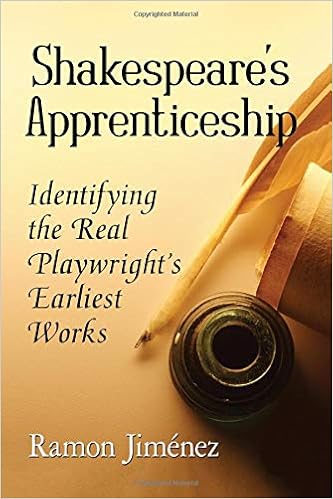
Note: Here is what our mainstream brethren might read to see the latest scholarship on this effect from a bespeak of view other than their ain: the first-class work of Ramon Jimenez published in 2018:
.

Re-Posting Number 12 of 100 Reasons Why Milk shake-speare was the Earl of Oxford: The Queen's Men
Role Ane
In 1583, as Philip of Kingdom of spain prepared to invade and conquer England, the British regime created a new interim company equally part of secret service activities, which included wartime propaganda to promote patriotic loyalty and unity. This new troupe, the Queen Majesty's Players or Queen Elizabeth's Men, was formed at the express command of the monarch. Drawing the best actors from existing companies, it became the dominant theatrical group in the crucial years leading to England'southward victory in 1588 over the Spanish Armada.
" data-medium-file="https://hankwhittemore.files.wordpress.com/2011/05/220px-the_true_tragedy_of_richard_the_third.jpg?w=210" data-large-file="https://hankwhittemore.files.wordpress.com/2011/05/220px-the_true_tragedy_of_richard_the_third.jpg?w=220" class="size-medium wp-image-1209" title="220px-The_True_Tragedy_of_Richard_the_Third" src="https://hankwhittemore.files.wordpress.com/2011/05/220px-the_true_tragedy_of_richard_the_third.jpg?w=209&h=300" alt="" width="209" height="300" srcset="https://hankwhittemore.files.wordpress.com/2011/05/220px-the_true_tragedy_of_richard_the_third.jpg?w=209&h=300 209w, https://hankwhittemore.files.wordpress.com/2011/05/220px-the_true_tragedy_of_richard_the_third.jpg?w=105&h=150 105w, https://hankwhittemore.files.wordpress.com/2011/05/220px-the_true_tragedy_of_richard_the_third.jpg 220w" sizes="(max-width: 209px) 100vw, 209px">
Although printed in 1594, "The True Tragedy of Richard the Third" was performed by the Queen's Men in the 1580's. Did "Shakespeare" steal it for his play "Richard Three"? Or was the existent author, Edward de Vere, building upon his own previous work?
The Queen'due south Men performed what were, by all appearances, early versions of royal history plays published later every bit by Shakespeare. "The plots of no fewer than vi of Shakespeare's known plays are closely related to the plots of plays performed by the Queen's Men," Scott McMillin and Sally-Beth MacLean write inThe Queen's Men and their Plays (1998).
" data-medium-file="https://hankwhittemore.files.wordpress.com/2011/05/200px-famousvictorieshenry5titlepage.jpg?w=196" data-large-file="https://hankwhittemore.files.wordpress.com/2011/05/200px-famousvictorieshenry5titlepage.jpg?w=200" class="size-medium wp-image-1210" title="200px-FamousVictoriesHenry5titlepage" src="https://hankwhittemore.files.wordpress.com/2011/05/200px-famousvictorieshenry5titlepage.jpg?w=196&h=300" alt="" width="196" height="300" srcset="https://hankwhittemore.files.wordpress.com/2011/05/200px-famousvictorieshenry5titlepage.jpg?w=196&h=300 196w, https://hankwhittemore.files.wordpress.com/2011/05/200px-famousvictorieshenry5titlepage.jpg?w=98&h=150 98w, https://hankwhittemore.files.wordpress.com/2011/05/200px-famousvictorieshenry5titlepage.jpg 200w" sizes="(max-width: 196px) 100vw, 196px">
Did "Shakespeare" use this early anonymous play for "1 Henry IV," "2 Henry IV" and "Henry V" Or was "The Famous Victories of Henry the Fifth" his own youthful play?
These histories includeThe Troublesome Reign of King John (repeated by Shakespeare "virtually scene for scene" in the Shakespeare playKing John);The Truthful Tragedy of Richard III andKing Leir (fully covered by Shakespeare in hisRichard III andMale monarch Lear); and likewiseThe Famous Victories of Henry the Fifth, which forms the entire foundation for the fabric in1 Henry Four, 2 Henry Four andHenry V.
In that location is no bear witness that Shakspere of Stratford was a member of this prestigious interim company. The likelihood is that he was however in Warwickshire for the birth of his twins in February 1585, when he was twenty years onetime. Past tradition, the "Lost Years" of that man begin in 1585 and continue until Robert Greene supposedly alludes to him in September 1592. Past and so, for the legendary story to be plausible, he has somehow firmly established himself in London as an thespian and as a promising, even prominent playwright able to provoke Greene'south jealousy.
None of this has whatsoever factual basis.
"Documentary evidence as to Shakespeare's whereabouts and activities from 1585 to 1592 is totally lacking," Oscar Campbell writes in The Reader's Encyclopedia of Shakespeare (1966), adding that "cypher can exist confirmed" about the Stratford man's life in that period. Traditional biographers cannot plausibly explain how "Shakespeare" was anonymously writing early versions of his plays for Her Majesty's visitor in the 1580'due south. Therefore, some advise he must have joined the Queen'south Men equally an actor and memorized the anonymous plays, which were written by others; and so, they propose, he drew upon his biggy retention to plunder their plots, characters, scenes and even lines, which would hateful the greatest writer of the English language linguistic communication was also the most successful plagiarist in history.
" data-medium-file="https://hankwhittemore.files.wordpress.com/2011/05/leir-1605-tp.jpg?w=205" data-large-file="https://hankwhittemore.files.wordpress.com/2011/05/leir-1605-tp.jpg?w=216" class="size-medium wp-image-1211" title="Leir-1605-tp" src="https://hankwhittemore.files.wordpress.com/2011/05/leir-1605-tp.jpg?w=205&h=300" alt="" width="205" height="300" srcset="https://hankwhittemore.files.wordpress.com/2011/05/leir-1605-tp.jpg?w=205&h=300 205w, https://hankwhittemore.files.wordpress.com/2011/05/leir-1605-tp.jpg?w=103&h=150 103w, https://hankwhittemore.files.wordpress.com/2011/05/leir-1605-tp.jpg 216w" sizes="(max-width: 205px) 100vw, 205px">
"The True Chronicle History of King Leir" was performed past the Queen's Men in the 1580's (but published in 1605) and transformed past "Shakespeare" into "Rex Lear"
Equally a mature dramatist in the 1590s, McMillin and MacLean declare, Shakespeare set well-nigh "rewriting a sizeable portion" of the repertory of the Queen's Men. "Four of 9 extant plays were turned into six Shakespeare plays, in an human action of appropriation extensive enough to make united states of america think it could have occurred from the inside." Such is the kind of deduction that can come up from an incorrect premise. "Shakespeare knew the plays of this company better than those of any company only his own, and the long-standing speculation that he may take begun his career with the Queen's Men seems to u.s.a. the most likely possibility."
" data-medium-file="https://hankwhittemore.files.wordpress.com/2011/05/pitcher-on-famous-victories.jpeg?w=214" data-large-file="https://hankwhittemore.files.wordpress.com/2011/05/pitcher-on-famous-victories.jpeg?w=470" class="size-medium wp-image-1212" title="PITCHER on Famous Victories" src="https://hankwhittemore.files.wordpress.com/2011/05/pitcher-on-famous-victories.jpeg?w=214&h=300" alt="" width="214" height="300" srcset="https://hankwhittemore.files.wordpress.com/2011/05/pitcher-on-famous-victories.jpeg?w=214&h=300 214w, https://hankwhittemore.files.wordpress.com/2011/05/pitcher-on-famous-victories.jpeg?w=428&h=600 428w, https://hankwhittemore.files.wordpress.com/2011/05/pitcher-on-famous-victories.jpeg?w=107&h=150 107w" sizes="(max-width: 214px) 100vw, 214px">
"The Case for Shakespeare's Authorship of 'The Famous Victories'" past Dr. Seymour Chiliad. Pitcher, 1961
A few scholars accept bravely stated the more realistic decision that Shakespeare himself must take written those earlier versions of his own plays, despite the fact that such a merits would rule out the Stratford homo. It requires Shakspere to have joined the Crown's prestigious acting company also early to fit his biographical fourth dimension frame. Fresh from life in the market town ninety miles from London, just xx years former in 1584, he turns out plays of English language majestic history nigh monarchs such as King John, Richard III, Henry IV and Henry V — a miraculous example of pulling one self up past the bootstraps if at that place e'er was 1.
(In 1961, for example, Dr. Seymour M. Pitcher at Harpur College in New York published an impressively argued book The Case for Shakespeare'southward Authorship of "The Famous Victories of Henry the Fifth" — referring to an early play that's a veritable pattern for Shakespeare'due south later trilogy about Prince Hal becoming Henry the Fifth. Every scene ofFamous Victories is repeated (and in the same order) by Shakespeare, who, Pitcher argued, must have written information technology when only "a spirited and genial amateur dramatist.")
Evidence withinThe True Tragedy of Richard the Third "reveals the high probability that it was Shakespeare himself who wrote that anonymous play," argues Ramon Jimenez, "and that his Richard Three was his major revision of i of his earliest attempts at playwriting." There are also "significant links" between the anonymous play and de Vere that "add to the evidence that he was the actual author of the Shakespeare catechism." Furthermore, Jimenez states, the evidence suggests that the anonymous play "was performed for an aristocratic audience, possibly including Queen Elizabeth herself, in the early 1560'south, when de Vere was betwixt 13 and fifteen years old."

The scholar Ramon Jimenez, speaking at an authorship conference on the Campus of Concordia University in Portland OR
Function TWO
Oxford was thirty-three in 1583, when Elizabeth's company was formed by the direct order of Walsingham, head of the government's intelligence operations, simply as the war between England and Spain was becoming official. During the adjacent crucial years, leading up to the victory over Philip's Armada in 1588, the new visitor would perform at court in winter and carve up into two traveling troupes in summer. With its actors wearing the queen's livery, the wartime company staged dozens of bearding plays of English language royal history throughout the state to promote patriotic loyalty and unity.
During the 1580s, the Queen'south Men performed works that "Shakespeare" would afterward plow into mature plays. Moreover, the tape shows that Oxford his secretary Lyly were connected to Elizabeth's from the outset. These two facts provide potent evidence that the author of the earlier works performed past the Queen's Men was Oxford himself, and that it was he who revised his ain previous plays for which"Shakespeare" would get the credit.
" data-medium-file="https://hankwhittemore.files.wordpress.com/2011/05/leir-1605-tp1.jpg?w=205" data-large-file="https://hankwhittemore.files.wordpress.com/2011/05/leir-1605-tp1.jpg?w=216" class="size-medium wp-image-1222" title="Leir-1605-tp" src="https://hankwhittemore.files.wordpress.com/2011/05/leir-1605-tp1.jpg?w=205&h=300" alt="" width="205" height="300" srcset="https://hankwhittemore.files.wordpress.com/2011/05/leir-1605-tp1.jpg?w=205&h=300 205w, https://hankwhittemore.files.wordpress.com/2011/05/leir-1605-tp1.jpg?w=103&h=150 103w, https://hankwhittemore.files.wordpress.com/2011/05/leir-1605-tp1.jpg 216w" sizes="(max-width: 205px) 100vw, 205px">
"The True Chronicle History of King Leir" — acted by the Queen's Men in the 1580's, published in 1605, and the principal source of Shakespeare'south "King Lear"
Oxford had returned from Italy in 1576 and it appears he proceeded to write plays brought to the royal court by the Children of St. Paul'south and by his corking friend and supporter Thomas Radcliffe, third Earl of Sussex. Oxford had served with him in the armed services campaign of 1570, confronting the northern Catholic earls in rebellion against the Protestant rule of Elizabeth. Sussex was now Lord Chamberlain of the Queen'south Household and patron of the start Lord Chamberlain'due south interim company. Ii examples:
* On New Year's Day 1577 at Hampton Court the Paul's Boys performed "The historie of Error," which may well exist an early version of The Comedy of Errors.
* in Febrary 1577 at Whitehall Palace the Lord Chamberlain'due south Men performed "The Historie of the Solitarie Knight," probable an early version ofTimon of Athens.
In improver to his patronage of writers, Lord Oxford now had charge of 2 acting companies, one (Oxford's Men) of adults and the other (Oxford'southward Boys) of choir boys from both Her Majesty's Children and Paul's Boys. He had the total sanction of the regime; in the mid-1580s, for case, Burghley and Sussex recommended to Cambridge University that Oxford's Men be immune to "prove their cunning in several plays already practiced by them earlier the Queen'southward Majesty."
Moreover, Oxford saved the individual Blackfriars playhouse from extinction by paying for the lease. This venue was frequented past aristocrats and students, its performances functioning as rehearsals for appearances in front of Elizabeth at court. Then he passed the lease on to Lyly, who acted equally director-manager. So Oxford was now at the heart — he was the centre — of the new awakening of English drama leading to "Shakespeare" in the adjacent decade.

Thomas Radcliffe, 3rd Earl of Sussex (1526-1583), Oxford'southward friend and surrogate father, whose Lord Chamberlain's Men brought plays to Court until his death
Sussex was near death when the gild came downward on 10 March 1583 to Edmund Tilney, Master of the Revels, that her Majesty'south new interim company be formed. In event the Queen's Men would replace the Chamberlain's Men. Assigned to gather the personnel was Walsingham, who had no personal interest in the theatre, merely was withal quite enlightened of its persuasive ability.
The formation of the Queen's Men signaled a new awareness by the Privy Council of the potential for combining theatrical action and espionage, since players frequently traveled, nationally and internationally. This new adult company could serve the Crown in multiple ways, such as collecting information useful to Walsingham's intelligence network.
The spymaster assembled the Queen's Men by enlisting the dozen all-time performers from all the existing companies. These included the Dutton brothers, leading players of Oxford'southward Men; and the popular clown Richard Tarlton, taken from Sussex'south troupe, who quickly became the star of Elizabeth'south Men.
"The new Queen'south Company made its showtime appearance at the beginning of the Court season on December 26, 1583," Ward reports in The Seventeenth Earl of Oxford from Contemporary Documents (1928). "On Jan. ane, 1584 a performance was given past Oxford's Men; and as John Lyly appears in the Chamber Accounts as payee for the visitor on that date, at that place is every reason to believe that the play acted was Lyly'southCampaspe. On March 8, 1584 both Oxford's and the Queen'south Men performed; in one case once again Lyly was payee for Oxford'south Men …
"Now, information technology seems unreasonable to suppose that ii plays were presented on this day; the most likely solution, therefore, would be that the 2 companies [Oxford'south and the Queen'south] were confederate and apposite by Lord Oxford's private secretary John Lyly, the author of the play. No other adult companies likewise these ii appeared at Court during this season."
Oxford was positioned to reply to the Crown'south need for patriotic plays of English royal history, and, too, he was involved in the creation and functioning of the Queen'due south Men, whose adult professional actors performed anonymous plays that "Shakespeare" would transform into masterpieces.
Note: This post is at present No. 42 of 100 Reasons Milk shake-speare was the Earl of Oxford.
Reason No. 25 to Believe that Edward de Vere Earl of Oxford was Shakespeare: His Grant of a Thousand Pounds Per Year

English ships boxing Spain's Armada - 1588
On June 26, 1586, when England was officially at state of war with Spain and bracing for King Philip's invasion by armada, Queen Elizabeth signed a warrant granting Edward de Vere Earl of Oxford an extraordinary allowance of a one thousand pounds per year. The grant was to be paid to him by the Exchequer, according to the aforementioned formula used for payments toSecretary Francis Walsingham and his wartime secret service, that is, to be made in quarterly installments with no accounting required.

Queen Elizabeth I (1533-1603)
At this time the English government desperately needed all available cash for military defence, to secure Elizabeth'south safety and the survival of her realm; and Walsingham required a abiding flow of greenbacks to pay foreign and domestic spies for his network of espionage. Back in 1582 the Queen had given him 750 pounds; in 1586 she raised it to 2 thousand pounds; just that would be the limit for her spymaster — even during 1588, the year of England's surprising victory over the Armada.

Sir Francis Walsingham (1532-1590)
So why would Elizabeth — known for being a most parsimonious (some would say miserly) monarch — cull to support a "spendthrift" nobleman who had "wasted" the vast bulk of his great inheritance? And why would she authorize such a big annual pension to be paid to him right now, of all times, at this nearly perilous moment for the nation?
Oxford'southward grant apparently went unnoticed by historians until 2 years afterwards John Thomas Looney published "Shakespeare" Identified in Edward de Vere the Seventeenth Earl of Oxford in 1920. Inspired to carry further inquiry, B. M. Ward discovered Elizabeth'due south signature on the Privy Seal Warrant then looked at surviving records for all other salaries and annuities paid from the Exchequer during her reign. Aside from sums paid to James of Scotland for political reasons, he found, the grant to Oxford was larger than any other except for the annual 1,200 pounds to the Main of the Posts for the expenses of that office.
As Ward noted in his 1928 documentary biography The Seventeenth Earl of Oxford, there's no hint as to the purpose of the grant, except that information technology was "to exist continued unto him during Our pleasure, or until such time as he shall be by us otherwise provided for to be in some mode relieved, at what time our pleasure is that this payment of one thou pounds yearly to our said cousin in fashion above specified shall terminate." The warrant also stated that the Exchequer was not to call upon Oxford to render any account of its expenditure, equally in the case of secret service money.

Blackfriars Playhouse - In the 1580's Oxford gave the charter of it to John Lyly
Edward de Vere at age thirty-half dozen was in fact broke and needed "to be in some manner relieved," just the circumstantial prove clearly suggests he had been working with Secretarial assistant Walsingham (and his father-in-law, William Cecil Lord Burghley) to serve the government'south interests. The evidence points to him playing a multi-faceted role behind the scenes that included, but was non limited to, the issuance of his own "comedies" for the stage – as the bearding writer of The Arte of English language Poesie would write in 1589: "For tragedy Lord Buckhurst and Master Edward Ferrys do deserve the highest praise: the Earl of Oxford and Master Edwards of Her Majesty's Chapel for Comedy and Enterlude."
Oxford actively patronized two interim companies performing at the private Blackfriars Playhouse and at the majestic courtroom. He patronized and/or employed many literary men for whom he provided working space, inspiration, guidance and liberty from the wartime suppression of written words and speech. Some of the writers in his service, such as Anthony Munday and Thomas Watson, operated as Clandestine Service agents (equally did Christopher Marlowe) while using their artistic activities every bit public cover; and others working under his wing included Robert Greene, John Lyly and Thomas Lodge, to name simply a few more.
It was Walsingham himself who had initiated formation of Queen Elizabeth'south Men in 1583. (He had received his get-go regular assart for espionage later on years of financing it from his own pocket, but as Oxford had been financing acting companies, writers and musicians with his personal funds.) The Secretary ordered the twelve best actors from existing companies to be transferred into the new Queen's Men. Then in January 1584 Oxford's adult visitor performed at Court with his secretarial assistant Lyly as payee; and in March that year Oxford'south company performed with the Queen's players at Courtroom, again with Lyly handling the business organisation side.
And so the two interim companies had been confederate, with Oxford's secretary apparently serving as business concern agent, phase managing director and rehearsal omnibus. In other words, soon later the caput of the Secret Service had spawned Her Majesty'south ain interim grouping, Edward de Vere rushed to contribute in various ways to its success. Meanwhile, the plots of several royal history plays performed in the 1580's by the Queen'south Men – including The Famous Victories of Henry the Fifth, The Troublesome Reign of King John and The True Tragedy of Richard III – would appear in the 1590'southward and later as about the same plots of plays attributed to Shakespeare.

The bearding play The Famous Victories of Henry the Fifth was performed by the Queen'south Men in the 1580'south
"The formation of the Queen's Men in 1583 should exist regarded especially in connection with the intelligence system," Scott McMillin and Sally-Beth MacLean write in The Queen'southward Men and Their Plays. "The indicate is not that the Queen'due south Men were spies, merely that traveling players wearing the Queen'southward livery would have been useful to Walsingham – perhaps for occasionally bearing letters to the right persons, more manifestly for showing that the key government was attending to the nation through its licensed travelers."
With at least two companies e'er on bout, the Queen's Men performed plays that would rouse patriotic fervor and encourage unity amongst Protestants and Catholics in the confront of the coming Spanish invasion. (To call this "propaganda" would be true, only non the whole of it.) And I suggest, first of all, that Oxford had spent much of his fortune on helping to bring the European Renaissance to England – on his travels in 1575-1576 through France, Germany and Italy; and on his employment of diverse artists who would create the smashing surge of English literature and drama in the 1580's, leading to "Shakespeare" in the following decade.
In a real sense Edward de Vere was a leader (or the leader) in creating a new English language, culture and national identity — weapons as important equally ships and guns in building upwards England'south ability to withstand assail. And nosotros could non expect to find these matters written down in the Queen'south Privy Seal Warrant authorizing his grant.
Six decades afterwards, the Rev. John Ward, vicar of Stratford Parish in Warwickshire, recorded local rumors in his diary (1661-1663) that "Shakespeare" had "supplied the phase with 2 plays every year and for that had an allowance and so big that he spent at the rate of a thousand pounds a year."

The Armada Battle
In fact Oxford received his annual thousand pounds during the remainder of the Anglo-Spanish War, from 1586 through the decease of Elizabeth in 1603 and the succession of Male monarch James, until his own death in 1604. That amounts to a full of eighteen years; and, of course, eighteen years times two plays per twelvemonth equals 30-half-dozen plays, the number of them published in the Showtime Folio of Shakespeare in 1623. Coincidence?
Reason No. 12 (Office Ii) Why Oxford was "Shakespeare" — With the Cosmos of the Queen's Men in 1583, he had the opportunity, the ways, and the motive!

Sir Francis Walsingham, the spymaster who assembled the Queen's Men in 1583
Edward de Vere Earl of Oxford was 33 in 1583, when Queen Elizabeth's company of adult actors was formed past the directly order of Sir Francis Walsingham, head of the government's intelligence operations, simply as the war between England and Spain was becoming official. During the next crucial years, leading up to the victory over Rex Philip's armada in 1588, the new visitor would perform at Court in winter and then in summertime divide into two traveling troupes. With its actors wearing the Queen'due south livery representing Her Majesty and the Crown, the wartime company staged anonymous plays of English language royal history to promote patriotic loyalty and unity.
During the 1580's the Queen's Men performed works that "Shakespeare" would later plough into mature plays such asRex John, Richard III, i Henry IV, 2 Henry IV, Henry V and King Lear; and the record shows that Lord Oxford and John Lyly, his individual secretary and stage manager, were closely continued to the Queen's Men from the start. When put together, these two facts provide strong evidence that the author of the before works performed by the Queen's Men was Oxford himself, and that it was he who revised his own previous plays for which"Shakespeare" would get the credit.
" data-medium-file="https://hankwhittemore.files.wordpress.com/2011/05/leir-1605-tp1.jpg?w=205" data-large-file="https://hankwhittemore.files.wordpress.com/2011/05/leir-1605-tp1.jpg?w=216" class="size-medium wp-image-1222" title="Leir-1605-tp" src="https://hankwhittemore.files.wordpress.com/2011/05/leir-1605-tp1.jpg?w=205&h=300" alt="" width="205" height="300" srcset="https://hankwhittemore.files.wordpress.com/2011/05/leir-1605-tp1.jpg?w=205&h=300 205w, https://hankwhittemore.files.wordpress.com/2011/05/leir-1605-tp1.jpg?w=103&h=150 103w, https://hankwhittemore.files.wordpress.com/2011/05/leir-1605-tp1.jpg 216w" sizes="(max-width: 205px) 100vw, 205px">
"The True Chronicle History of King Leir" -- acted by the Queen's Men in the 1580'south, published in 1605, and the principal source of Shakespeare's "King Lear"
Oxford had returned from Italy in 1576 and it appears that he proceeded to write plays that were brought to the royal court by the Children of St. Paul's and by his friend Thomas Radcliffe, tertiary Earl of Sussex, who was a kind of father effigy to him. [Oxford had served with him in the military campaign of 1570 against the northern Cosmic earls in rebellion confronting Elizabeth.] Sussex was also Lord Chamberlain of the Queen's Household and patron of the outset Lord Chamberlain's interim visitor. Two examples: (i) On New year's Day 1577 at Hampton Courtroom the Paul's Boys performed "The historie of Error," which sounds like an early on version of The Comedy of Errors attributed to Shakespeare; and (2) in Febrary 1577 at Whitehall Palace the Lord Chamberlain'south Men performed "The Historie of the Solitarie Knight," which may have been a version of Shakespeare's drama Timon of Athens.
When Edward de Vere was thirty in 1580 his secretary Lyly brought out his second book Euphues and His England, defended to Oxford and depicting an "Italianate" Englishman just like the earl himself. (The ii books, which Oxford may have partially or wholly dictated, were nigh the commencement English novels.) Besides in his service was Anthony Munday, whose Zelauto, the Fountain of Fame of 1580 was the second volume he dedicated to Oxford; and in the same year Oxford also took complete charge of the Earl of Warwick's adult acting visitor, whose leading men were the brothers Lawrence and John Dutton.
In addition to his patronage of writers, Lord Oxford at present had charge of two interim companies, one consisting of adults (Oxford's Men) and the other (Oxford's Boys) consisting of choir boys from both Her Majesty'southward Children of the Regal Chapel and Paul's Boys. And he had the full sanction of the regime; for example, his begetter-in-police William Cecil Lord Burghley, the Queen's powerful primary minister, along with Lord Chamberlain Sussex, recommended to Cambridge Academy in mid-1580 that Oxford'due south Men should exist immune to "show their cunning in several plays already expert by them before the Queen'south Majesty."
In 1583 Edward de Vere stepped forth to save the private Blackfriars Playhouse from extinction, past paying for the charter of this celebrated performance space. (Information technology was frequented past aristocrats and students, with performances operation as rehearsals for appearances in forepart of Queen Elizabeth at Courtroom.) Soon afterward he passed on the charter to John Lyly, his director-manager. Oxford was at present at the very center of the new awakening of English literature and drama in England that would lead to "Shakespeare" in the following decade.
Thomas Radcliffe, 3rd Earl of Sussex (1526-1583), Oxford's friend and surrogate father, whose Lord Chamberlain's Men brought plays to Court until his death
Oxford'southward friend the Lord Chamberlain Sussex fell ill and was nearing death when the social club came down on March 10,1583 to Edmund Tilney, Primary of the Revels, that Her Majesty'south acting company be formed. In effect the Queen's Men would take over from the Chamberlain'due south Men. (Sussex died that June.) Assigned to assemble the personnel was surreptitious service director Walsingham, who had no personal intendance for the theatre and had probably never set human foot in a playhouse; just he was quite enlightened of the ability of the drama.
As the Walsingham biography in Wikipedia observes, formation of the Queen's Men "also signaled a new awareness on behalf of the Queen and the privy council of the potential for combining theatrical and espionage activities, since players frequently traveled, both nationally and internationally, and could serve the Crown in multiple ways, including the collection of information useful to Walsingham's spy network."
The spymaster assembled the Queen'southward Men by first enlisting the twelve best performers from all the existing companies. These of course included Oxford'southward Men, whose leading players the Dutton brothers equally well every bit other actors were transferred into Her Majesty'due south troupe. The popular clown Richard Tarlton was taken from Sussex's troupe the Chamberlain'southward Men and he quickly became the star of the Queen's Men, which was now the largest company of actors in English Renaissance theatre.
"The new Queen's Visitor made its commencement advent at the starting time of the Court flavor on Dec 26, 1583," B.Thou. Ward reported in The Seventeenth Earl of Oxford from Contemporary Documents (1928). "On January 1, 1584 a performance was given by Oxford'southward Men; and equally John Lyly appears in the Chamber Accounts as payee for the visitor on that engagement, there is every reason to believe, with Sir Edmund Chambers, that the play acted was Lyly'sCampaspe. On March 8, 1584 both Oxford'southward and the Queen's Men performed; once once again Lyly was payee for Oxford's Men, and Sir Edmund confidently conjectures that the play acted was Sapho and Phao.
"At present, information technology seems unreasonable to suppose that 2 plays were presented on this day; the virtually probable solution, therefore, would be that the two companies [i.east., Oxford's and the Queen's] were amalgamated and apposite by Lord Oxford's private secretary John Lyly, the author of the play. No other developed companies also these ii appeared at Court during this season … The simplest solution is surely the one I have suggested, viz., that when the Queen'due south Company captivated some of Oxford's leading actors Lyly was lent unofficially [starting in 1584] as stage manager and coach."
So Edward de Vere Earl of Oxford was in position to reply to the Crown's need for patriotic plays of English language royal history; and, too, he was very much involved in the creation and functioning of the Queen's Men, whose actors would perform anonymous plays in the 1580's that "Shakespeare" would later transform into masterpieces — another potent link in the chain of testify that Oxford and "Shakespeare" were one and the same dramatist.
Was "Shakespeare" a Copycat? Thief? Plagiarist? THE QUEEN'S MEN: No. 12 of 100 Reasons Why Edward de Vere was "Shakespeare" – Part 1
" data-medium-file="https://hankwhittemore.files.wordpress.com/2011/05/queens-men-cover.jpeg?w=204" data-large-file="https://hankwhittemore.files.wordpress.com/2011/05/queens-men-cover.jpeg?w=470" class="size-medium wp-image-1214" title="QUEEN'S MEN COVER" src="https://hankwhittemore.files.wordpress.com/2011/05/queens-men-cover.jpeg?w=203&h=300" alt="" width="203" height="300" srcset="https://hankwhittemore.files.wordpress.com/2011/05/queens-men-cover.jpeg?w=203&h=300 203w, https://hankwhittemore.files.wordpress.com/2011/05/queens-men-cover.jpeg?w=406&h=598 406w, https://hankwhittemore.files.wordpress.com/2011/05/queens-men-cover.jpeg?w=102&h=150 102w" sizes="(max-width: 203px) 100vw, 203px">
"The Queen's Men and their Plays" by McMillin and MacLean, 1998
In 1583, as Philip of Spain prepared to invade and conquer England, the British government created a new acting company as office of Secret Service activities including wartime propaganda to promote patriotic loyalty and unity. This new troupe, Queen Elizabeth'southward Men, was formed at the express command of the monarch. Drawing the best actors from existing companies, it became the dominant theatrical group in the crucial years leading to England's victory in 1588 over the Spanish fleet.
" data-medium-file="https://hankwhittemore.files.wordpress.com/2011/05/220px-the_true_tragedy_of_richard_the_third.jpg?w=210" data-large-file="https://hankwhittemore.files.wordpress.com/2011/05/220px-the_true_tragedy_of_richard_the_third.jpg?w=220" class="size-medium wp-image-1209" title="220px-The_True_Tragedy_of_Richard_the_Third" src="https://hankwhittemore.files.wordpress.com/2011/05/220px-the_true_tragedy_of_richard_the_third.jpg?w=209&h=300" alt="" width="209" height="300" srcset="https://hankwhittemore.files.wordpress.com/2011/05/220px-the_true_tragedy_of_richard_the_third.jpg?w=209&h=300 209w, https://hankwhittemore.files.wordpress.com/2011/05/220px-the_true_tragedy_of_richard_the_third.jpg?w=105&h=150 105w, https://hankwhittemore.files.wordpress.com/2011/05/220px-the_true_tragedy_of_richard_the_third.jpg 220w" sizes="(max-width: 209px) 100vw, 209px">
Although printed in 1594, "The Truthful Tragedy of Richard the Tertiary" was performed past the Queen's Men in the 1580's. Did "Shakespeare" steal information technology for his play "Richard III"? Or was the real author, Edward de Vere, edifice upon his own previous work?
During that flow the Queen's Men performed what were, by all appearances and by all logic, early on versions of purple history plays by Shakespeare. "The plots of no fewer than six of Shakespeare's known plays are closely related to the plots of plays performed past the Queen'south Men," co-ordinate to Scott McMillin and Sally-Beth MacLean inThe Queen's Men and their Plays (1998).
" data-medium-file="https://hankwhittemore.files.wordpress.com/2011/05/200px-famousvictorieshenry5titlepage.jpg?w=196" data-large-file="https://hankwhittemore.files.wordpress.com/2011/05/200px-famousvictorieshenry5titlepage.jpg?w=200" class="size-medium wp-image-1210" title="200px-FamousVictoriesHenry5titlepage" src="https://hankwhittemore.files.wordpress.com/2011/05/200px-famousvictorieshenry5titlepage.jpg?w=196&h=300" alt="" width="196" height="300" srcset="https://hankwhittemore.files.wordpress.com/2011/05/200px-famousvictorieshenry5titlepage.jpg?w=196&h=300 196w, https://hankwhittemore.files.wordpress.com/2011/05/200px-famousvictorieshenry5titlepage.jpg?w=98&h=150 98w, https://hankwhittemore.files.wordpress.com/2011/05/200px-famousvictorieshenry5titlepage.jpg 200w" sizes="(max-width: 196px) 100vw, 196px">
Did "Shakespeare" utilize this early on bearding play for "1 Henry 4," "two Henry 4" and "Henry V" Or was "The Famous Victories of Henry the 5th" his own youthful play?
The known plays in this category areThe Troublesome Reign of King John, repeated by Shakespeare "virtually scene for scene" inRex John;The True Tragedy of Richard 3 andKing Leir, whose stories are fully covered by Shakespeare in hisRichard Iii andKing Lear; andThe Famous Victories of Henry the Fifth, which forms the unabridged foundation for the material that Shakespeare covers ini Henry Iv, ii Henry IV andHenry V.
The trouble, even so, is lack of any evidence that Shakspere of Stratford was a fellow member of this prestigious acting company. The likelihood is that he was withal dorsum home in Warwickshire when his twins were born in February of 1585, when he was 20 years old. In other words, the beingness of early Shakespeare plays performed by the Queen's company in the 1580'southward presents a major problem for the official biography. You might say it blows it apart.
By tradition the "Lost Years" of the Stratford man begin in 1585 and continue until Robert Greene supposedly alludes to him in the autumn of 1592. By then, for the legendary story to be plausible, he has somehow firmly established himself in London equally an actor who is already prominent plenty equally a playwright to provoke Greene's jealousy and ire.
But this is pure fantasy. "Documentary prove equally to Shakespeare's whereabouts and activities from 1585 to 1592 is totally defective," Oscar James Campbell writes in The Reader'south Encyclopedia of Shakespeare (1966), calculation that "null tin be confirmed" well-nigh the Stratford man'southward life in that flow.
Traditional biographers accept had a terrible time trying to explain how "Shakespeare" was anonymously writing early versions of his plays for Her Majesty'southward visitor in the 1580's. Some take suggested he must have joined as an actor and memorized the bearding plays; then in the 1590'south, they propose, he drew upon his retention to plunder the plots, characters, scenes and fifty-fifty the lines of those stage works, whichwould hateful that the greatest author of the English language language must have also been the well-nigh successful plagiarist in history!
" data-medium-file="https://hankwhittemore.files.wordpress.com/2011/05/leir-1605-tp.jpg?w=205" data-large-file="https://hankwhittemore.files.wordpress.com/2011/05/leir-1605-tp.jpg?w=216" class="size-medium wp-image-1211" title="Leir-1605-tp" src="https://hankwhittemore.files.wordpress.com/2011/05/leir-1605-tp.jpg?w=205&h=300" alt="" width="205" height="300" srcset="https://hankwhittemore.files.wordpress.com/2011/05/leir-1605-tp.jpg?w=205&h=300 205w, https://hankwhittemore.files.wordpress.com/2011/05/leir-1605-tp.jpg?w=103&h=150 103w, https://hankwhittemore.files.wordpress.com/2011/05/leir-1605-tp.jpg 216w" sizes="(max-width: 205px) 100vw, 205px">
"The True Relate History of King Leir" was performed by the Queen'due south Men in the 1580'southward (but published in 1605) and transformed by "Shakespeare" into "Male monarch Lear"
As a mature dramatist in the 1590'southward, McMillin and MacLean declare, Shakespeare gear up about "rewriting a sizeable portion" of the repertory of the Queen's Men. "Iv of ix extant plays were turned into vi Shakespeare plays, in an act of cribbing extensive enough to brand u.s.a. remember it could take occurred from the inside. Shakespeare knew the plays of this company better than those of whatsoever company but his own, and the long-continuing speculation that he may have begun his career with the Queen's Men seems to u.s.a. the most probable possibility." (And this leads them to call up he must have recalled these works from acting in them during the 1580's.)
" data-medium-file="https://hankwhittemore.files.wordpress.com/2011/05/pitcher-on-famous-victories.jpeg?w=214" data-large-file="https://hankwhittemore.files.wordpress.com/2011/05/pitcher-on-famous-victories.jpeg?w=470" class="size-medium wp-image-1212" title="PITCHER on Famous Victories" src="https://hankwhittemore.files.wordpress.com/2011/05/pitcher-on-famous-victories.jpeg?w=214&h=300" alt="" width="214" height="300" srcset="https://hankwhittemore.files.wordpress.com/2011/05/pitcher-on-famous-victories.jpeg?w=214&h=300 214w, https://hankwhittemore.files.wordpress.com/2011/05/pitcher-on-famous-victories.jpeg?w=428&h=600 428w, https://hankwhittemore.files.wordpress.com/2011/05/pitcher-on-famous-victories.jpeg?w=107&h=150 107w" sizes="(max-width: 214px) 100vw, 214px">
"The Example for Shakespeare's Authorship of 'The Famous Victories'" by Dr. Seymour M. Pitcher, 1961
Just some few scholars have bravely stated the far more than realistic conclusion that Shakespeare himself wrote those earlier versions of his ain plays. In 1961, for case, Dr. Seymour M. Pitcher at Harpur College in New York wrote an impressively argued book The Case for Shakespeare'due south Authorship of "The Famous Victories of Henry the Fifth".
That early play serves as a veritable pattern for Shakespeare's later trilogy nigh Prince Hal becoming the great Henry the Fifth who leads the English to victory at Agincourt. Every single scene in Famous Victories is repeated (and in the same club) by Shakespeare, who must take written the earlier version when he was "a spirited and genial apprentice dramatist," Dr. Pitcher ended, adding it "may accept been his kickoff play."
Orthodox scholars have ignored Dr. Pitcher'southward suggestion, considering information technology requires Shakspere to join the Crown's prestigious interim company too early on to exist plausible. Fresh from his life in the marketplace town ninety miles from London, age xx in 1584, he turns out plays of English royal history about monarchs such as King John, Richard Tertiary, Henry Quaternary and Henry Fifth – a miraculous instance of pulling oneself up by the bootstraps, if at that place e'er was one.
A study of The Truthful Tragedy of Richard the Third "reveals the high probability that it was Shakespeare himself who wrote that anonymous play," according to the highly respected Oxfordian scholar Ramon Jimenez, "and that his Richard III was his major revision of one of his earliest attempts at playwriting."
The scholar Ramon Jimenez, speaking at an authorship conference on the Campus of Concordia University in Portland OR
There are also "pregnant links" between the anonymous play virtually Richard the Third and Edward de Vere, 17th Earl of Oxford "that add to the evidence that he was the actual author of the Shakespeare canon."
Furthermore, Jimenez states, "The show suggests that the anonymous play was performed for an aristocratic audience, possibly including Queen Elizabeth herself, in the early 1560's, when de Vere was between thirteen and fifteen years former."
In the second office of Reason No. 12 we'll take a look at the Earl of Oxford'south activities in relation to the Queen's Men in the 1580'southward and the likelihood that he was contributing those anonymous, early versions of plays which he himself would revise later, for eventual publication under the "Shakespeare" pen name.
Source: https://hankwhittemore.com/tag/queens-men/
0 Response to "what prompted shakespeare to join the queens men?"
Post a Comment